OpenAI just released its latest model family, GPT-5.6. If you’ve been through these releases before, you know there’s a lot of hype around better performance, capabilities, benchmarks, and more. What does this actually mean for you if you’re a business leveraging AI for practical, real-world tasks?
In our testing, GPT-4o Mini, GPT-5 Mini, and GPT-5.6 Luna all produced acceptable responses to sample customer support cases, but at considerably different costs.
What matters when evaluating an AI model for customer support?
For customer support, two of the biggest evaluation metrics are cost and performance. From a performance lens, the model needs to accurately follow instructions, call tools and leverage external data where appropriate, and produce an acceptable response based on the SOPs provided. We usually evaluate performance across a large set of responses. Here, we’ll take a look at a single sample support case to see how model choice impacts quality and cost.
How we tested GPT-5.6 Luna, GPT-5 Mini, and GPT-4o Mini
For this example, we’ve pulled a real support case that our AI agent processed and regenerated the response with three different models: GPT-4o Mini (released July 2024), GPT-5 Mini (released August 2025), and GPT-5.6 Luna (released just now in July 2026). These models were all the latest and greatest small model at one point in time, but they represent vastly different price points (over a 10x increase when comparing output token cost).
All other variables remained the same: the models had access to the same customer context and tooling to retrieve additional details.
Does GPT-5.6 perform better for customer support?
You can check out the response each model generated for yourself below, but in short: they all produce acceptable and effectively equivalent responses on this sample case, which is representative in complexity of a majority of many brands’ support volume. Each model correctly retrieved the information the user asked for, followed the company’s response guidelines, and generated a response that communicates the necessary information to the user. They’re slightly different stylistically, and while you could say that one might be better than the other, this type of variance can also occur when regenerating a response with the same model.
GPT-4o Mini
Response cost: $0.0042Hi [redacted],
Your subscription is active, and here are the details:
Products:
- [redacted]
- [redacted]
- [redacted]
- [redacted]
- FREE: [redacted]
Next Billing Date: Access Subscription Portal
If you're having trouble logging in, please try resetting your password. If the issue persists, let me know if there's an alternative email you would like me to check for you.
GPT-5 Mini
Response cost: $0.0090Hi [redacted], thanks for the note. I located an ACTIVE subscription under [redacted].
- [redacted]
- [redacted]
- [redacted]
- [redacted]
- One-time free: [redacted]
Next shipment / billing date: [redacted].
You can view and manage your subscription here: Manage your subscription
If the app isn't recognizing you, please try that link and make sure you sign in with [redacted]. Would you like me to make any changes to your subscription or check a different email for you?
GPT-5.6 Luna
Response cost: $0.0302Hi [redacted], I'm sorry the app didn't recognize you. Your subscription is active and your latest payment was successful.
Your monthly subscription includes:
- [redacted]
- [redacted]
- [redacted]
- [redacted]
Your next order is scheduled for [redacted].
Please use the subscription management portal to access your account and manage your subscription.
Would you like us to make any changes to your subscription?
How much did each response cost?
The cost difference was significant: GPT-4o Mini generated an acceptable response for less than half the cost of GPT-5 Mini, and roughly one-seventh the cost of GPT-5.6 Luna.
While the generation cost for a single response with any given model is low, once you start to scale this across a support operation for a growing business, the savings from choosing the appropriate model can be substantial.
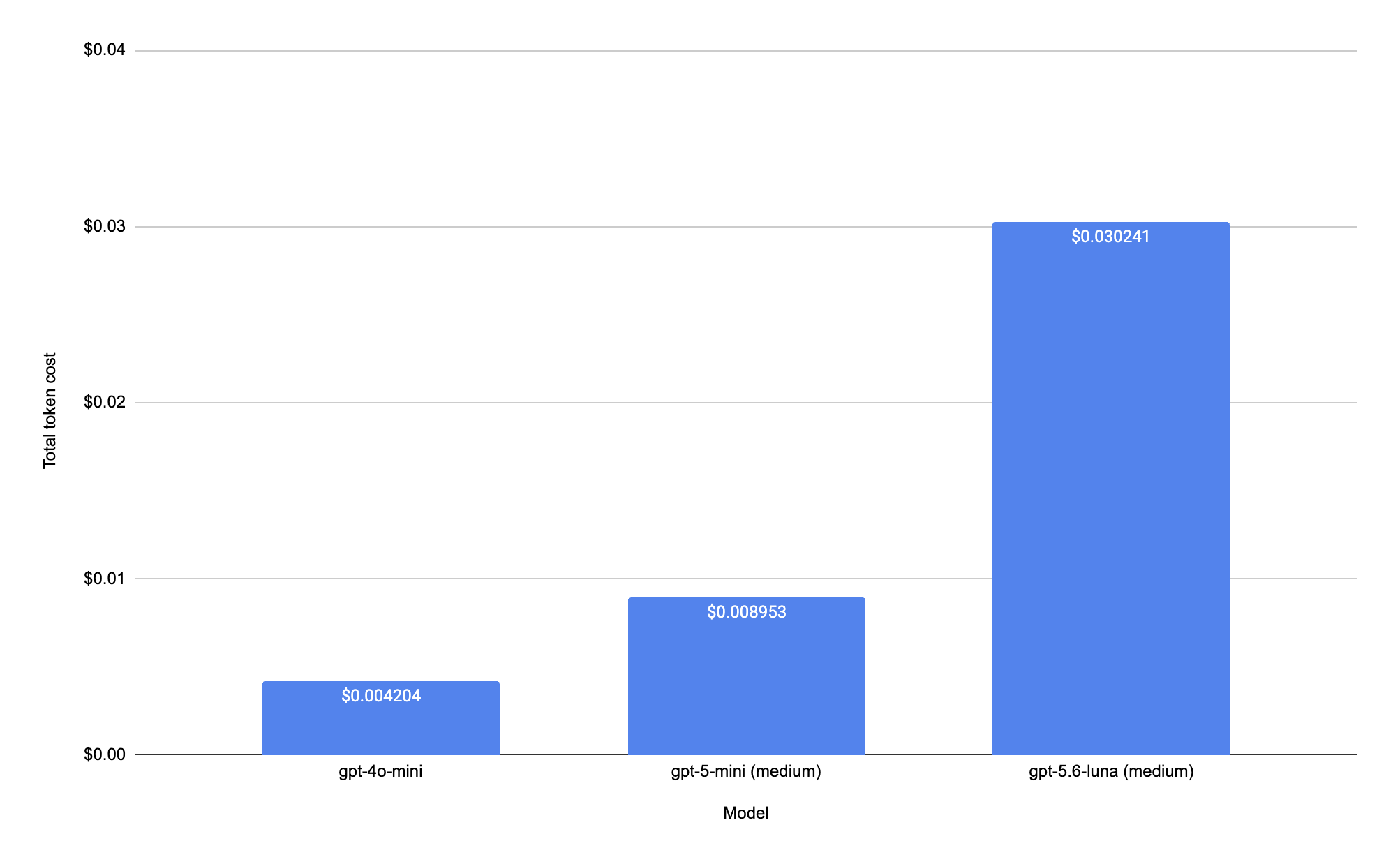
| Model | Uncached input | Cached input | Cache writes | Output | Total cost |
|---|---|---|---|---|---|
| GPT-4o Mini | 12,373 tokens$0.001856 | 6,656 tokens$0.000499 | — | 372 tokens$0.001849 | $0.004204 |
| GPT-5 Mini | 8,265 tokens$0.002066 | 6,656 tokens$0.000166 | — | 3,360 tokens$0.006720 | $0.008953 |
| GPT-5.6 Luna | 14,459 tokens$0.014459 | 1,113 tokens$0.000111 | 8,783 tokens$0.010979 | 782 tokens$0.004692 | $0.030241 |
Token counts and costs are combined across all API calls used to generate each response, which happens to be two in each example.
How do these costs scale?
We've made some basic assumptions to demonstrate how these costs might scale: an average of three AI responses per inquiry and a 25% increase in input context with each response.
| Support cases per month | GPT-4o Mini | GPT-5 Mini | GPT-5.6 Luna |
|---|---|---|---|
| 10,000 | $144 | $285 | $1,099 |
| 50,000 | $719 | $1,427 | $5,494 |
| 100,000 | $1,438 | $2,853 | $10,988 |
At 100,000 monthly cases this scenario produces an estimated $9,550 monthly, or $114,600 annual difference between GPT-4o Mini and GPT-5.6 Luna.
Why model routing matters for customer support automation
Here we’ve compared just three models from a single provider, but in reality there are thousands of different models you might consider. You have frontier models from OpenAI, Anthropic, Google, and others. Then you have open-source models, which often perform just as well at considerably lower cost. There’s a time and place for each of these, and choosing the right model for a particular task is incredibly important. Even within a single application (customer support), there might be inquiry types that a company receives that necessitate using a different model to achieve the desired response.
Should your support team use GPT-5.6?
Unless you’re building out your own customer support tooling internally, it’s likely that you aren’t choosing which model is used yourself; your technology provider is doing this for you. It’s still important, because those costs are ultimately being passed along to you.
It’s important to not just jump on the latest model because of internet hype, often the latest and greatest represents no practical difference for a lot of applications, and the aggregate cost increase can be considerable at scale.
How Valiopt optimizes model selection
Valiopt utilizes a proprietary, intelligent model selection system that chooses the right model at the right time, allowing us to pass along significant savings to our customers while maintaining peak performance. Get in touch to see how we can help you optimize your support operations.